
Mega Masters: The Definition Question (Part 3)
How should we define a mega master immigration court hearing? Setting a threshold, a time window, and the rules behind counting 100+ master calendar hearings in EOIR data, plus the June 2026 surge.

This is the third post in a series on the phenomenon of mega master calendar hearings, a new tactic used by the Trump administration to dramatically expand the number of people ordered deported at once. You may want to read the first two before continuing here. Those essays introduce the topic and explain the context needed to fully make sense of the analysis here.
It might be tempting to demand a clear and consistent definition of what we are calling a mega master hearing, but that demand would be misplaced. As far as I can tell, the term “mega master” emerged as a heuristic from the empirical observation of crowded courtrooms. Unlike the term “initial master calendar hearing,” it has no procedural definition. If the term has been used before, I can’t find it, and since the phenomenon is still emerging, its properties are not yet fixed. Unlike juvenile dockets or MPP courts, there is no institutional record suggesting that a mega master (or any equivalent formal term) exists as part of EOIR’s ontology.
Strictly speaking, a mega master is an event with certain properties of magnitude, but it is not an object in either a virtual or material sense. This is not the same as saying that mega master hearings do not “exist.” It only means that we have to distinguish between the various ways things exist, do not exist, and barely exist in law. My initial aversion to the term comes from this fact and from the sense that “mega masters” arrives too unprepared to provide analytical clarity and far too eager to insert itself into news headlines. I will use the term anyway, provided we agree that it is best used to prompt questions, not to provide answers.
So how do we start to pin down what to call a mega master hearing? Two questions face us. What numerical threshold should we use, and what time period counts as a single “event”?
Mega Masters Thresholds
There are basically two approaches to setting a threshold for mega masters hearings. One is absolute and the other is relative. We can define a mega master as crossing a certain threshold of people required to show up at one time, or we can define it as a certain increase beyond the norm. The threshold most often used so far is 100. There is no statistical justification for 100. Rather, it is factually true that many mega masters hearings have crossed 100, a rare occurrence historically, and 100 is a round number that people can grasp easily. It also works as a handy baseline. If the number of mega masters hearings grows, we can track that growth fairly easily.
But an absolute definition has drawbacks. Holding to 100 as a threshold would mask the explosive growth in courts that have gone from 15 hearings each morning to 50, or from 20 to 99. Sorting courts as either ≥100 or <100 biases us toward larger courts and can lead us to overlook significant changes in smaller ones. There are other options. We could examine growth multiples at courts against a localized baseline rather than a nationally imposed one, or we could build a stepped classification that counts how many courts fall into 0 to 24 scheduled hearings, 25 to 49, 50 to 74, and so on.
As I said, we are not going to choose one option as the single correct method. That might be good advocacy, but it is not good immigration data research. Instead, we are going to find a path into the work, explore it, and build in the flexibility to learn and evolve rather than predetermining our schema in advance. Having already gone down several of these paths, I am eager to unpack the complexity of this new court phenomenon. But for the sake of simplicity at the outset, and to test the already widely circulating threshold of 100, I will start there.
Mega Masters Events
Public and private reporting on mega masters typically describes 100 (or some other large number of) people showing up at a single time. We have settled the first part of that. We have not settled the second. What does it mean to show up for court “at a single time”?
Immigration court hearings typically run on a morning/afternoon split, which gives immigration judges two general time slots. From January 1 through June 30, 68% of master calendar hearings were scheduled in the morning and 32% in the afternoon. This reinforces the narrative that people have to show up for court in the morning. Most descriptive accounts of the immigration courts, from judges’ memoirs to journalists’ “day in the life of the court” stories, start with the mornings. Most legal support programs focus on those morning hearings. Hearings absolutely happen in the afternoons too, but mornings at court seem, in my experience, to have the most going on.
But even within the morning block, hearings can be scheduled on the half hour and staggered. There is no universal rule that all master calendar hearings must start at the same time across the country. So far this year, 35% of hearings were scheduled for 8:30 AM, 15% for 9:00 AM, and another 25% for 1:00 PM.
This brings us to another decision point. When we say “100 people at a time,” do we mean at a single calendar time, or in a block of time, meaning a morning or an afternoon? I will distinguish the two. I will use “call” or “call time” for hearings co-scheduled at a precise calendar time on a date, and “half-day docket,” or “morning” and “afternoon” (literally before 12pm and after 12pm), for all hearings scheduled in a morning or an afternoon. Note that judges do not necessarily hold master calendar dockets in both the morning and the afternoon, and they do not hold them every single day of the month.
Which method to use comes down to what we are trying to show. If we use only 8:30 AM, the most common call time, as the basis for mega masters, it leaves out courts that accumulate more than a hundred hearings over the course of a morning docket without any single time breaching our threshold. On the other hand, if 25 hearings are scheduled across four call times in a morning, that could legitimately reduce the pressure on the court at any single time. Practically speaking, people may still arrive early, which could nullify any procedural benefit of spreading the hearings out.
Since this is still our first pass at the data, I will adopt the simplest defensible strategy. We are looking at courtrooms with ≥100 hearings scheduled in a single half-day docket. Please do not quote me as saying this is the “correct” way to define it. I am not writing as an advocate or a journalist. I am writing as a researcher and public communicator who wants to make this work interesting and accessible. Depending on the analytical goal, the definition is likely to change, and that is normal.
Mega Masters Additional Criteria
I am also going to make a few other decisions to narrow the focus. The immigration court system is complex, and since we are responding to a phenomenon that has already been identified, staying as close as possible to what we already know lets us avoid entangling the analysis in other factors that could get in the way. So for now:
I am looking only at morning dockets and setting aside afternoon calls.
I am looking only at in-person master calendar hearings, not virtual ones.
I am looking only at non-detained hearings, not detained ones.
Mega Masters Provisional Definition
Let’s pause for a provisional definition. For this first pass at the research, we will say that a mega master calendar hearing is any morning where a single immigration judge in a single in-person non-detained courtroom was assigned more than 100 hearings.
Mega Masters Caveat
There is one essential caveat to interpreting the June findings presented below. EOIR’s hearings represent what was scheduled, not what actually happened. Because the EOIR data for this analysis runs only through the end of May, the June hearings represent what was on the calendar as of May 31. Hearings can still be cancelled or added when we look into the future. As I will show in later posts, many of these hearings are being scheduled with little notice, so the number reportedly scheduled on, say, June 22 (as of May 31) is very likely to rise rather than fall by the time we get final data through June 30. My initial analysis found about a 2.5x increase in actual versus projected hearings for May, so although on-the-ground reporting is less systematic, it is probably ahead of the data. Here is why. On June 1, which we do not have data for, some additional number of cases were scheduled for June 22, making the actual June 22 schedule equal to [hearings scheduled as of May 31] + n. On June 2, more hearings were scheduled for June 22. And so on. The hearing schedules do not lock at the end of the month just because the data does. The most reliable way to analyze the data is to look backward, not forward, and we are always 45 days behind reality with EOIR data (30 days, plus 15 days to release the data).
June Surge of Mega Masters Hearings
Using the definition above, we can see that mega masters hearings began increasing in May 2026, as reported, then surged in June (based on scheduled hearings so far). If May looks like an undercount, remember that we are using an artificial cutoff of 100. Several reports I read described the spike as dramatic, up to 75 in a single hearing, which is huge on its own, but not crossing 100. We will return to this question later in the series, so hang in there with me. As of the end of May, June was already scheduled out with 153 mega master calendar hearings, narrowly defined. Again, retrospective data next month will likely show that this was larger in reality, but it does not hurt to confirm the pattern prospectively.
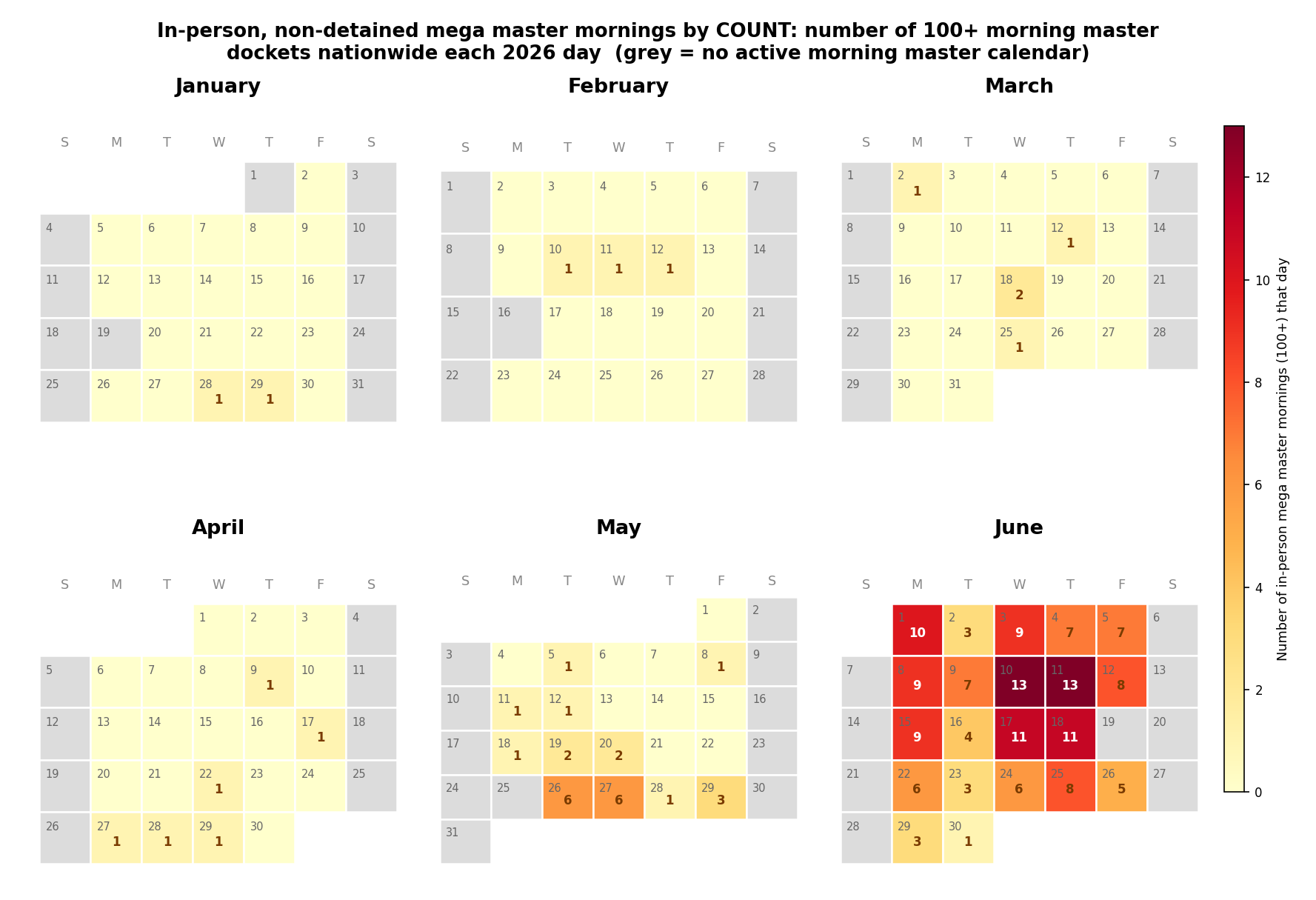
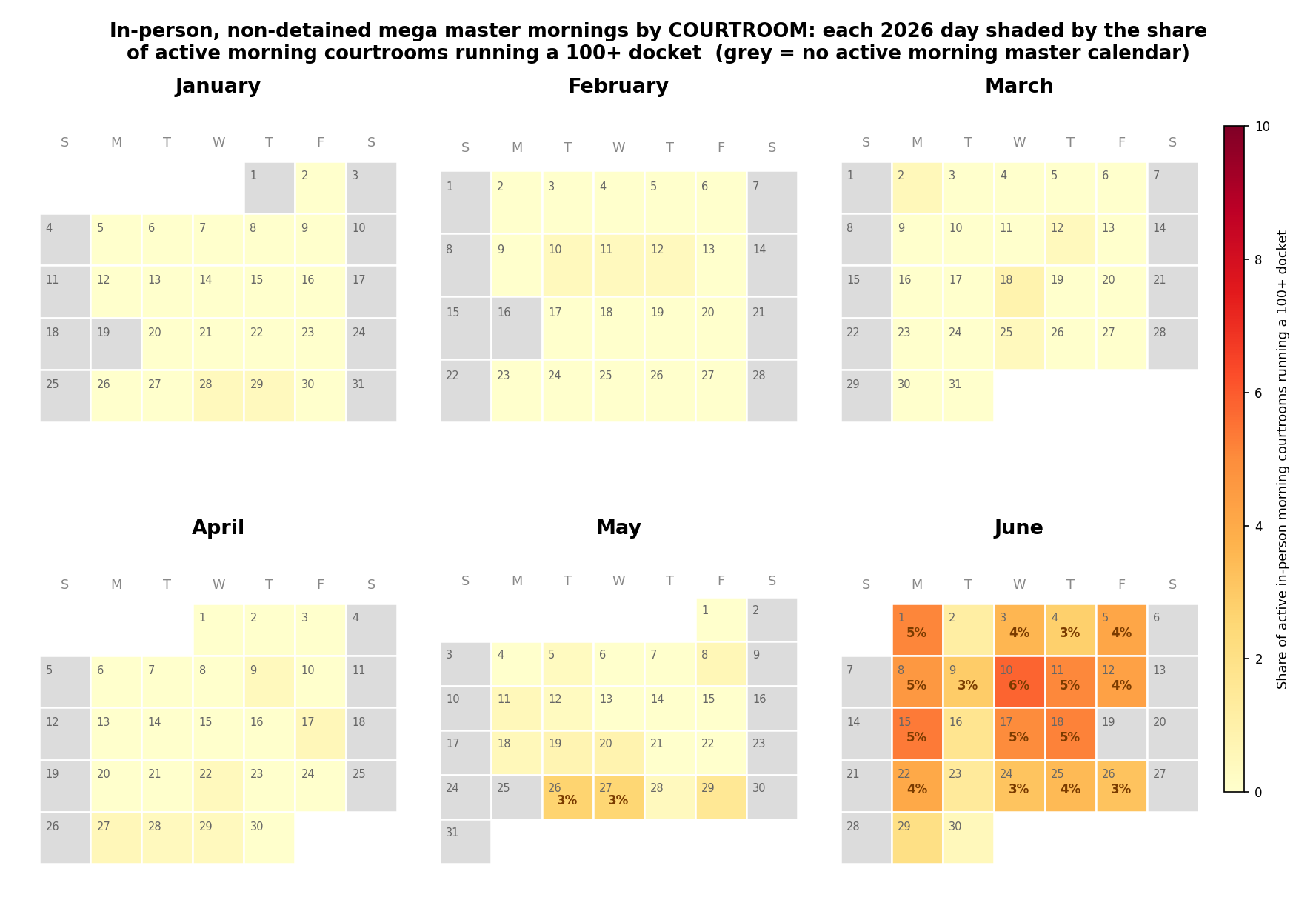
The visualization above shows only the total number of mega masters. Below, we see the percentage of master calendar hearings across the country that morning that qualified as a mega master hearing. Most master calendar hearings did not qualify as mega masters, although docket sizes are growing across the country. (Sorry, the color grading doesn’t match exactly across graphics, but I’m going to let go of my perfectionism for a minute so I can publish this and keep moving.)
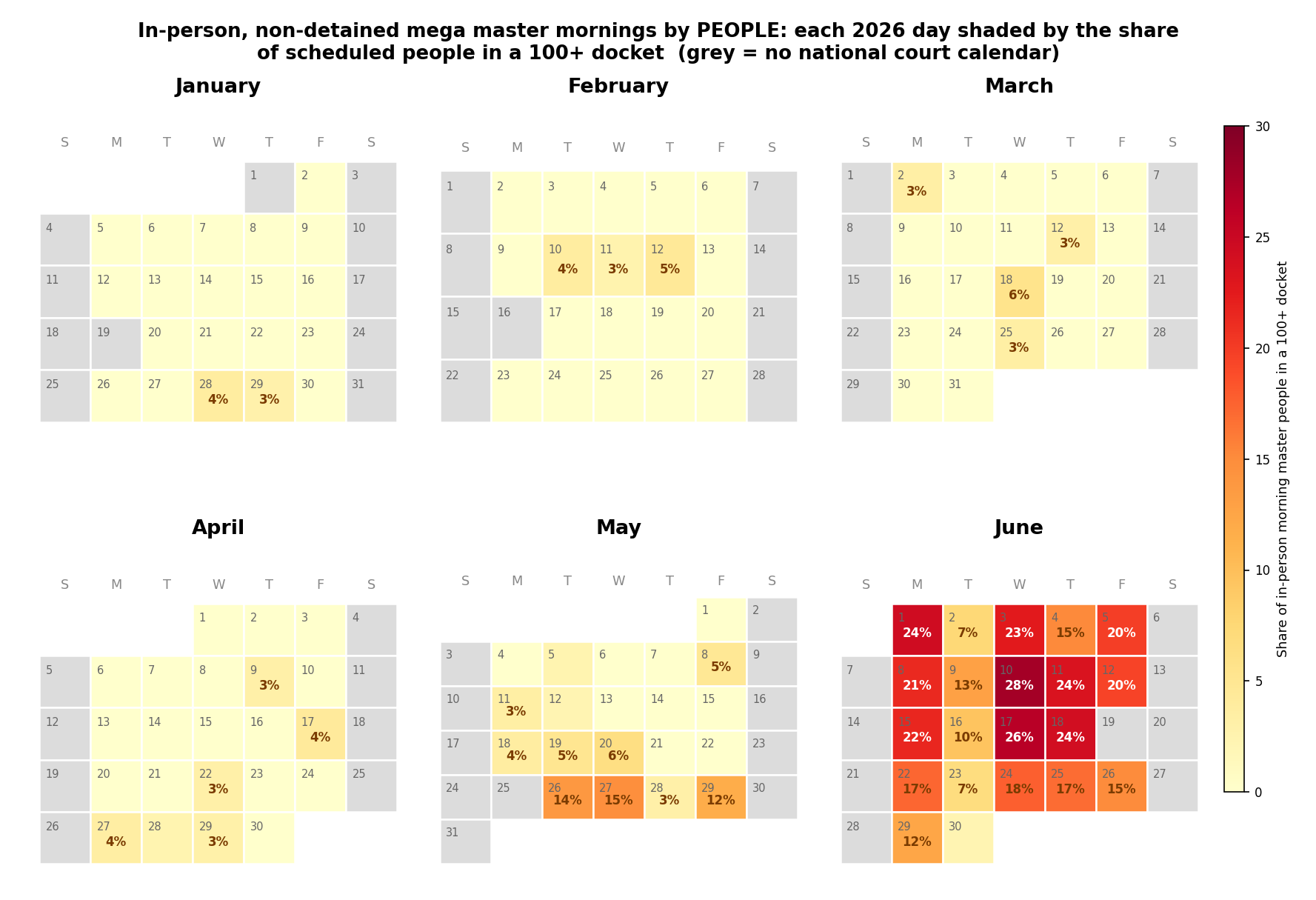
What is remarkable is that despite relatively few mega masters across the country, the number of people pulled into these courtrooms was huge. On June 10 and June 17, more than a quarter of all the people in the country required to attend a master calendar hearing were walking into one of these mega masters. And this was almost certainly an undercount.
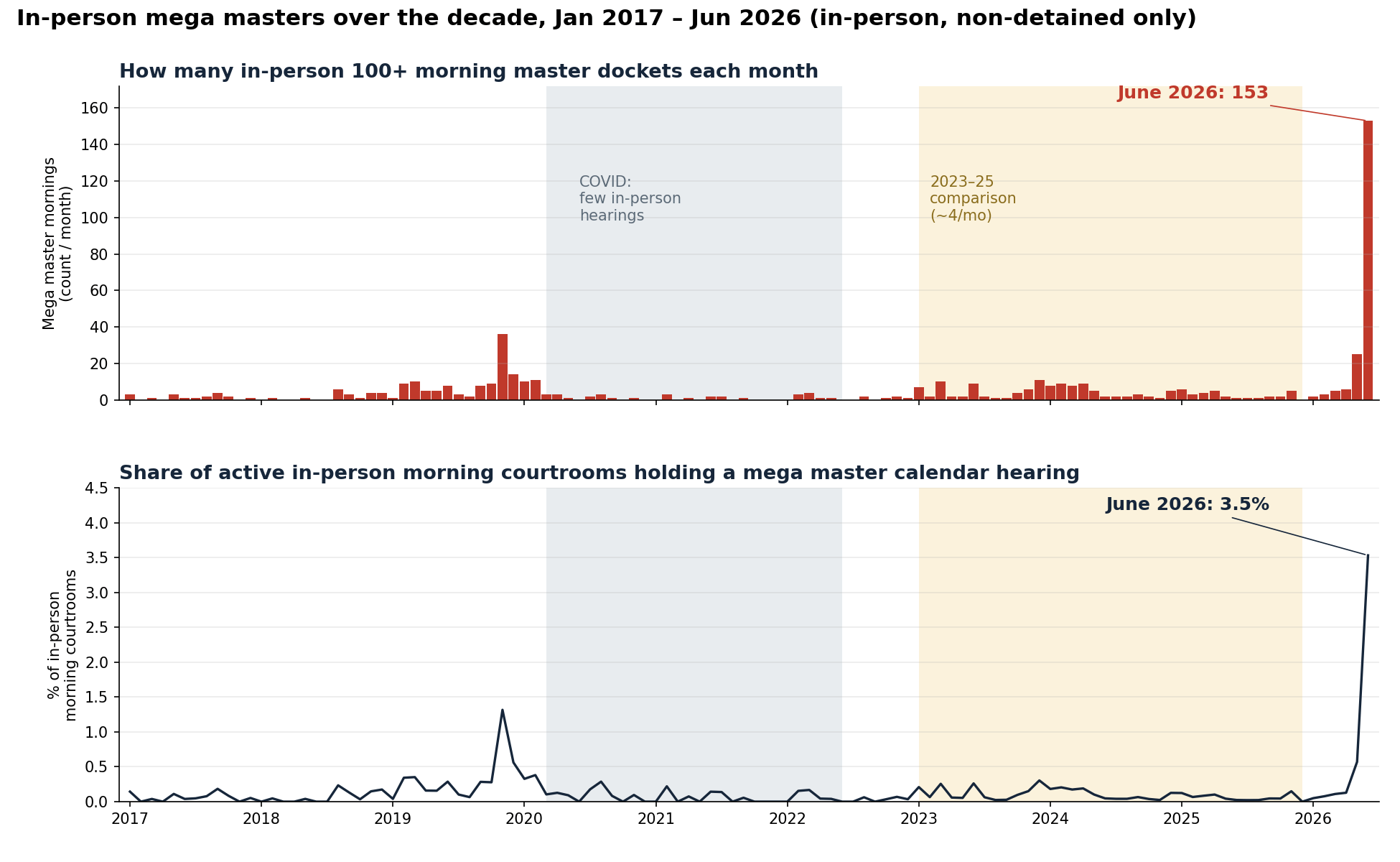
As I wrote in the previous post, the fact that the news media is reporting on mega masters does not mean they are new. Keeping our definition but using a longer historical horizon, we can see that this is not the first time since the start of the first Trump administration that a single month has had large numbers of mega masters. A previous spike occurred in late 2019, though nowhere near the level of June 2026. Earlier spikes may have occurred, but I have chosen to restrict my focus to the past 10 years.
What do you see?
Feel free to post comments, questions, observations, and criticisms big and small in the comments. The analysis is done on my end, so I am walking back through the analysis here for public benefit, but also so that I can learn from what you are seeing and to get input on the analysis throughout. Be a part of a learning community below.
Up Next!
Now that we have confirmed the upward trend in mega masters hearings, we will start to add dimension and depth to what these numbers mean, where they are happening, and who is affected, not to mention what actually happens to these cases once they reach court. Subscribe to get updates and to follow the growing list of posts on mega masters on my Substack homepage.
You are ignoring the fact that only half of those scheduled show up and that the liberal judges are constantly rescheduling individual merits hearings multiple times for the alien to obtain an attorney. Everyone knows that the alien is just attempting to delay any final decision and uses the MCH to delay and delay. Most don't show up because they know their claim is a lie, but their goal was entry and release, so they can enter the underground economy. If they get an EAD, then they are set for decades as they have a legitimate Social Security Card and can get a REAL ID. Even if deported those documents last for years and being in the underground economy is pretty much what they expected. And the Immigration Judge is the highest variable in approval of asylum. Some judges had as high as 98% approval rates of asylum claims, while the national average is 42%. All this fixation with making up a formula to show that MMCH are bad is just nonsense. The aliens know it and know they are exploiting a system designed for Mikhail Baryshnikov not some Colombian or Mexican lying about persecution.
I would like stats on how many judges had how many master hearings in each court in a month. I am interested in caseload and putative throughput being demanded of each judge in each court.