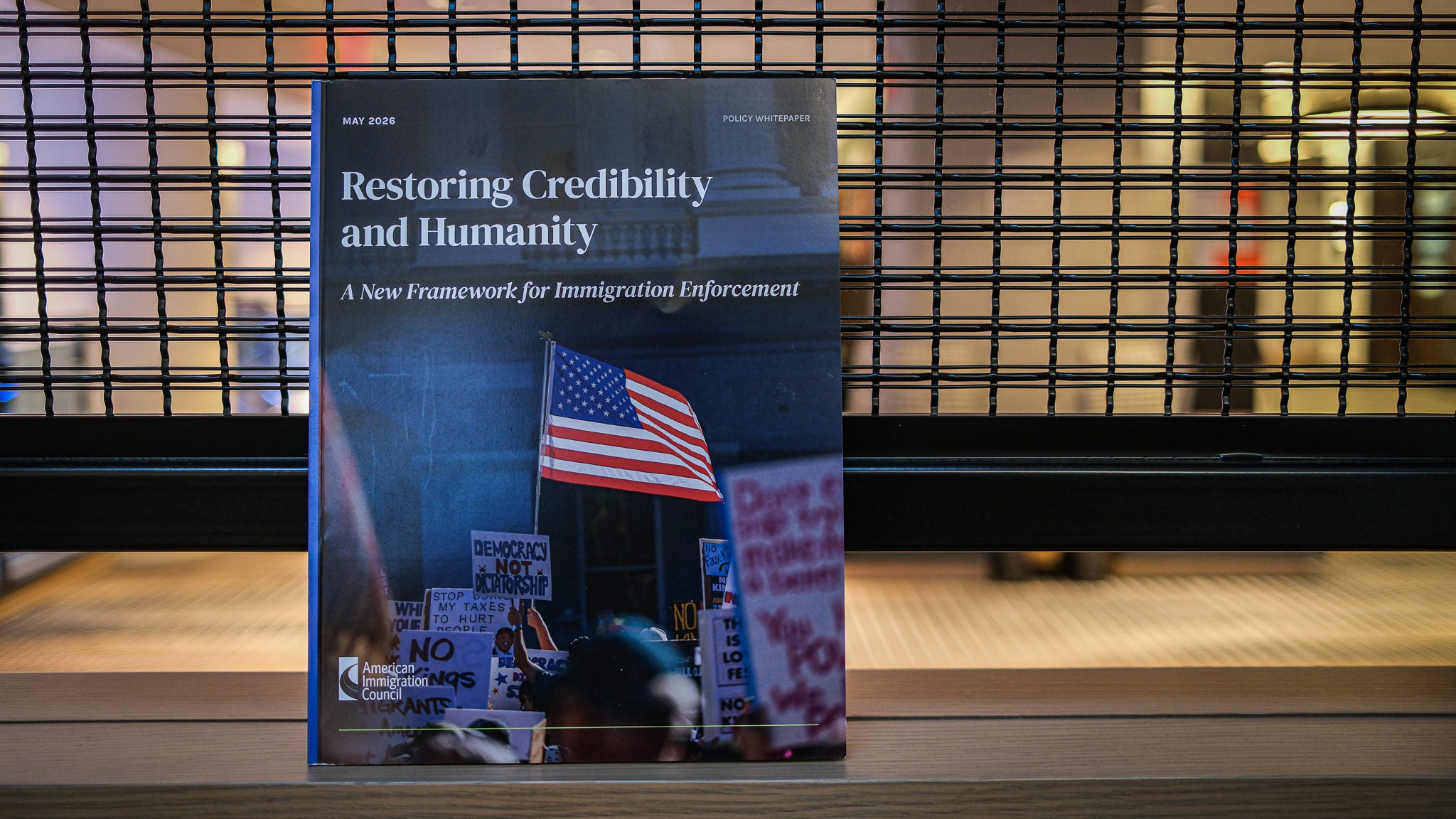
Rethinking Interior Enforcement: A Live Conversation with Nayna Gupta and Aaron Reichlin-Melnick of the American Immigration Council
The American Immigration Council's new framework for interior immigration enforcement proposes a credible, humane, and realistic path forward. Join me June 9 at 1 PM Eastern with the authors.

Most of us find it easier to criticize the current immigration enforcement system than to propose workable solutions that would actually reduce the harm it causes. Critique—a worthy exercise of intellectual energy, just to be clear—is often deployed in such a way as to remain altitudinally untethered from the more constrained terrain of political and legislative change. I unapologetically believe in the practical value of philosophy through the old adage that the way we define a problem is often part of the problem. But I also believe that the endless redefinition of social problems is a Möbius strip that needs cut. That’s why I’m increasingly interested in having conversations with people who are conceptualizing the frameworks for future immigration reforms (like Andrea Flores and Claire Trickler-McNulty) or advocating for reforms now (like Ashley DeAzevedo)—not because I endorse each one, but because I want to bring you with me to learn more about what is (and isn’t) possible from a practical policy-change perspective.
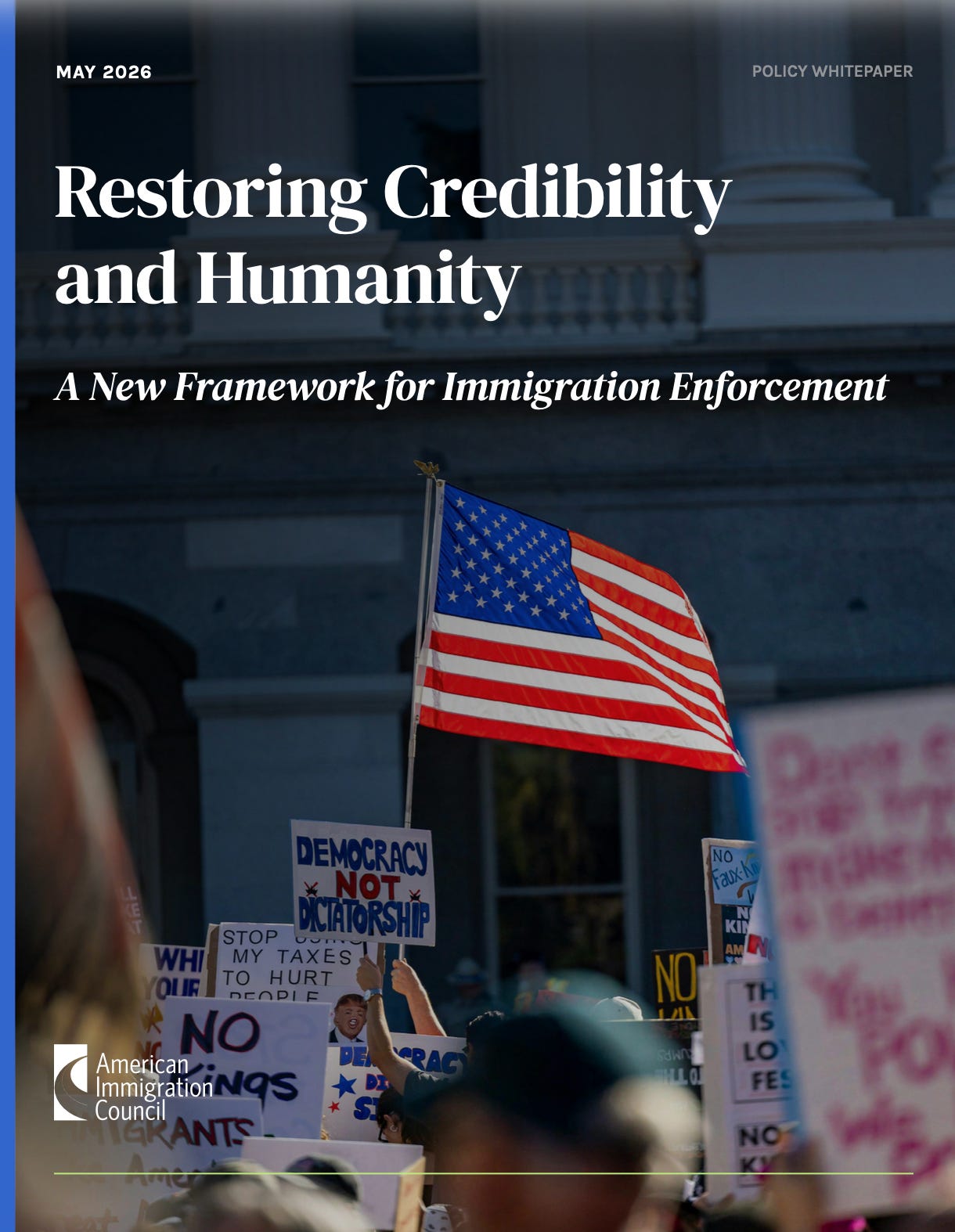
That’s why, when the American Immigration Council (AIC) released a new report titled Restoring Credibility and Humanity: A New Framework for Immigration Enforcement, I was really interested. A lot of organizations are releasing immigration reform frameworks these days; this isn’t the only one. But it is the only one so far that focuses squarely on interior enforcement, which is what most of my research has focused on over the years.
I want to emphasize why this framework is so distinctive. The term “interior immigration enforcement” is code for enforcement by Immigration and Customs Enforcement (ICE) in places away from the U.S.-Mexico border, where Border Patrol typically has jurisdiction. As Reece Jones has written, the geographic distinction between ICE and Border Patrol is not strict, which is why Border Patrol officers have been active on the ground during protests in Portland, Oregon, and during ICE enforcement sweeps in Minneapolis, Minnesota. But the distinction between interior and border enforcement still generally holds, and it holds for an important analytical reason: people arrested through interior enforcement differ in significant ways from people arrested through border enforcement. Interior arrests tend to impact people who have been in the United States much longer, often decades, are more likely to be well-established in the community through long-standing employment and deeper local social ties, and are more likely to be married to U.S. citizens or have U.S. citizen children. Although immigration law itself is notoriously inflexible on even the most trivial matters, these demographic factors shape public perception about the legitimacy of deportation as a solution to minor civil infractions. In short, even many militant advocates of border enforcement hesitate at the prospect of deporting someone who has lived here for 30 years, has a U.S. citizen spouse and children, works in the local economy, and poses no public safety threat. Reforming the interior enforcement system truly is its own beast, not disconnected from the rest of the immigration system, of course, but a topic worth grappling with on its own terms.
This report also emerges at a time when public confidence in interior immigration enforcement has collapsed, and for good reason. The past year has been defined by a cascade of images, stories, and data points make it clear that mass enforcement operations, unconstrained by proportionality or accountability, do not make communities safer and go against the basic values of a growing number of Americans. It’s not just liberals that are concerned; the president’s manic hyper-focus on deportations is costing him Republican support, too. The current barrage of chaotic arrests destabilize families, erode trust between immigrant communities and local institutions, and consume enormous resources without making America safer or more prosperous.
For all these reasons, I reached out to the two people who worked on the report, Nayna Gupta and Aaron Reichlin-Melnick from the American Immigration Council, and asked them to join me for a public virtual discussion about how they developed this framework, what it would mean in practice, and how the framework has been received so far. No one—certainly no one I’ve ever talked to in the policy world—thinks that any single proposal is perfect or that any single reform will be sufficient to solve the range of problems endemic to our immigration system. And whatever proposals have existed in the past are almost certainly out of step with where we are now. So as the first proposal to focus squarely on a topic area I'm deeply invested in understanding, this conversation is important to me, and it's something I think you should care about too.
Nanya and Aaron generously agreed to talk with us about their work next Tuesday, June 9, at 1:00 PM Eastern. We’ll talk about the essential building blocks of the report as well as behind-the-scenes question, including:
what drove the collapse of public confidence in the current enforcement model and why that matters for any path forward
what “proportionality” and “accountability” actually mean as enforcement principles
how the framework addresses the intersection of criminal justice and immigration enforcement, one of the most contested and consequential areas of interior policy
what policymakers, advocates, and local governments can realistically do with a framework like this, and what it would take to implement it
what the data reveals about who interior enforcement is actually targeting and whether that matches the stated priorities
As always, this will be a substantive conversation. Whether you’re a researcher, journalist, attorney, organizer, or policymaker trying to think seriously about what comes next, you’re welcome to join us and bring your questions.
Event Details
Date: June 9, 2026
Time: 1 PM Eastern
Format: Virtual (Zoom)
Registration: Free and open to the public
Recording: The event will be recorded and shared as a podcast post here on Substack.
Registration is free and required.
About Our Guests
Nayna Gupta is Policy Director at the American Immigration Council, where she leads the Council’s legislative, administrative, and policy advocacy portfolio. Her work focuses on immigration enforcement, detention, and the intersection of criminal and immigration law, which puts her at the table where reforms like the ones in this framework get developed and argued.
Aaron Reichlin-Melnick is a Senior Fellow at the American Immigration Council, where he studies the impact of immigration enforcement at the border and inside the United States. He tracks enforcement statistics, court rulings, and agency actions closely, and reporters and researchers across the field rely on his analysis of how the current administration has used, and in many cases stretched, its legal authority. You can follow his prolific work on Bluesky and X.